Ad placeholder
Turn-based mode
Turn-based mode is one of the two gameplay modes in Baldur's Gate 3, in which time passes in turns and rounds, as opposed to real-time mode, where events occur in real-time. Story events and cutscenes could be considered a third gameplay mode, in which nether turn-based nor real-time action are possible; it could also be considered not a mode at all, but outside of normal gameplay.
Each round, the game cycles through each participating creature's turn, during which each creature may move or take actions. One round passes when all creatures complete their turn.
Overview[edit section | visual editor]

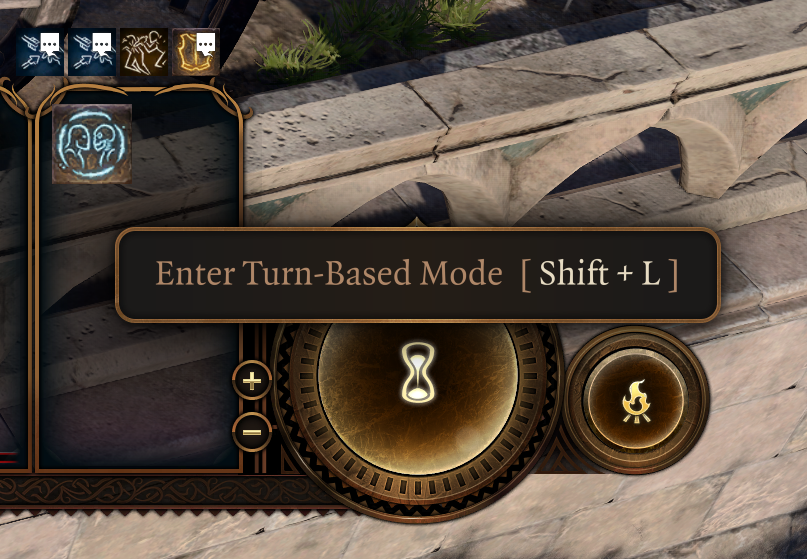
Turn-based mode activates automatically at the start of combat, and when certain traps or hazardous environmental effects are triggered. It automatically toggles off when combat ends, or when conditions which trigger it end.[verify]
The player can toggle turn-based mode on and off outside of combat. In some instances, it ends automatically despite having been toggled on by the player.[verify]
If a party member partaking in combat moves far enough away, the player can flee combat with that character, which ends turn-based mode for them, while others remain in combat.
Entering turn-based mode by any means freezes events for all creatures and objects in combat-range proximity of the character(s) it is activated with, while events continue as normal outside of this range.
Entering dialogue does not toggle on turn-based mode, allowing real-time events to continue occurring in the vicinity. However, if the player switches to a party member who's not part of the dialogue, they can toggle on turn-based mode explicitly. During certain special dialogues, the game doesn't allow this, displaying the text: "There's an interesting conversation nearby."[verify][1]
Turn order[edit section | visual editor]
Upon entering combat, each creature in the vicinity makes a 
Each round, the game cycles through the turns of all participating creatures in descending order of their initiative.
Simultaneous turns[edit section | visual editor]
Allied creatures usually take their turns at the same time when they are in close proximity to each other and are directly adjacent to each other in the turn order. Up to a maximum of 10 creatures may take their turns interchangeably in this way. However, summoned creatures which are not controlled by their summoner are not considered allies, and thus do not get to take their turns at the same time as their summoner.
Surprise rounds[edit section | visual editor]
If an attacked creature is unaware of their attacker at the start of combat – such as if the attacker is 

Surprised creatures retain the
Creatures with the 


Action economy[edit section | visual editor]
When taking their turns, creatures are able to move a distance up to their movement speed[5], and can expend their available resources to take actions.
Actions are generally taken in order to deal damage or inflict harmful conditions, but they can also be taken to heal or otherwise aid allies.
Most actions require the acting creature to expend one of three resources:


By default, a creature has 1 charge each of these three resources which always recharge at the start of their turn. However, additional resources can also be acquired through various means.
Reactions[edit section | visual editor]
Reactions are a form of action that can be taken by creatures as a response to certain triggers, including on the turns of other creatures. These often require the acting creature to spend a 
Notes and references[edit section | visual editor]
- ↑ In what may be considered an exploit, this limitation can be bypassed by initiating combat. A known example is the tribunal dialogue with Sarevok Anchev. During Impress the Murder Tribunal, when Sarevok summons a murder victim's ghost, the player can switch to a different party member, and try to steal from or attack the ghost to force turn-based mode.
- ↑ Certain feats, passives, and items prevent surprise.
- ↑ Certain combat encounters are rigged to always Surprise either the player's party or the enemy party when the proper conditions are met.
- ↑ While surprised creatures are unable to take actions, some can warn nearby allies, preventing them from becoming surprised too.
- ↑ Movement speed can be modified by a wide variety of circumstances such as areas, class features, feats, items, races, and spells.