Ad placeholder
Damage

Damage is a number which represents how deadly a threat is. When a creature takes damage, their current hit point total is reduced by the amount specified.
Damage is dealt with attacks and other harmful actions, as well as by a variety of conditions.
Damage rolls[edit section | visual editor]
The base damage dealt by a weapon, spell, class action, or condition is usually determined by a damage roll. Damage rolls always have an associated damage type that is given in dice notation, e.g., 1d4

Damage modifiers[edit section]
Modifiers added to damage rolls are only added once per source, even if multiple dice are rolled.
Whether an ability score modifier is added to a damage roll depends on the attack:
- When making weapon attacks, the attacking creature usually adds the same ability score modifier to both the attack roll and damage roll.
- Ability score modifiers are not normally added to damage rolls for spells and spell attacks, unless specifically enabled by a feature such as


Example[edit section | visual editor]
A successful attack with a dagger does a base of 1d4


Attacks[edit section | visual editor]
Generally, to damage a target when making an attack, attackers must first succeed on an attack roll. Attack rolls are rolled against the target's AC. If the roll is greater than or equal to the target's AC, the attack is a hit, and the attacker then rolls for damage. If the result is less than the target's AC, the attack is a miss, and no damage is rolled. However, in some instances, damage is dealt even on a miss (e.g., 

Attack roll modifiers[edit section | visual editor]
Attack rolls are always made using an associated ability:
- Unarmed attacks, melee weapon attacks, and thrown weapon attacks generally add the attacking creature's Strength modifier.
- Attacks made with ranged weapons add the creature's Dexterity modifier.
- Attacks from weapons with the


- Spell attacks add the caster's spellcasting ability modifier, generally determined by their class.


Spell attacks, unarmed attacks, and attacks with weapons that the attacker is proficient with also add their proficiency bonus. Certain attacks add extra modifiers as well:
- If the attacker is using an enchanted weapon, the enchantment value is added, from +1 to +3.
- According to high ground rules, attacking from at least 2.5 m (8 ft) above applies a +2 bonus to the attack roll, while attacking from at least 2.5 m (8 ft) below applies a -2 penalty.
Attack rolls are also modified by:
- Class Features - e.g.,

- Coatings - e.g.,

- Conditions - e.g.,

- Feats - e.g.,

- Items - e.g.,

- Spells - e.g.,


Critical hits[edit section | visual editor]

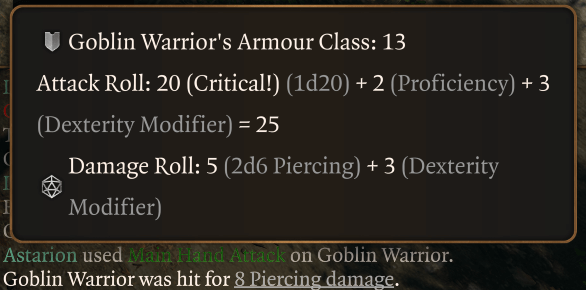
When a creature rolls a natural 20 on an attack roll, the attack is a critical hit. Critical hits automatically land regardless of the target's AC, and the attacker also rolls twice the normal number of dice to determine damage dealt, including additional dice such as those from smites or manoeuvres. However, some items (e.g., 
Modifiers and flat bonuses (i.e., any bonus that does not involve dice) – including the creature's relevant ability score modifier – are not doubled.
Some feats, class features, and items reduce the critical hit threshold by 1, allowing attack rolls to land critical hits by rolling either 19 or 20. Multiple sources of this effect stack, allowing the critical hit threshold to go below 19.
If an adamantine weapon strikes an object, the hit is always critical.Damage types[edit section | visual editor]
All damage has a damage type, of which there are 13:


Bludgeoning, Piercing, and Slashing damage are sometimes collectively referred to as Physical damage. Acid, Cold, Fire, Lightning, Poison, and Thunder damage are sometimes collectively referred to as Elemental damage. However, other non-Physical damage types are also occasionally treated as "elemental damage" (and some of the normally included types are sometimes excluded), as seen in features such as 


This wiki sometimes uses the term Weapon damage when the damage type is based on the primary damage type of the weapon being used. Almost all weapons, melee or ranged, deal one of the physical damage types, although there are exceptions, such as the 


If a source of damage mixes different sizes of dice or damage types, they are listed separately with a plus sign between them, e.g., 1d8
Resistance, Vulnerability and Immunity[edit section | visual editor]
A creature's resistances determine which damage types they are immune, resistant, or vulnerable to:
- Damage dealt to a creature with resistance to that damage type is halved.
- Damage dealt to a creature with vulnerability to that damage type is doubled.
- Damage dealt to a creature with immunity to that damage type is reduced to 0.
Resistance and vulnerability to the same type cancel each other out, but do not affect immunity.
Damage roll mathematics[edit section | visual editor]
Due to the mathematics of dice rolls, the difference between, say, 1d8 and 2d4 is more than just the higher minimum value of 2 on the roll of 2d4. With the d8, each outcome has the same probability. One has an equal chance of getting a 5 and an 8. On the other hand, the 2d4 roll is statistically more likely to lead to a total value of 5, rather than a total value of 8. This is better explained with a table of all possible outcomes:
| + | 2nd roll | ||||
|---|---|---|---|---|---|
| 1 | 2 | 3 | 4 | ||
| 1st roll | 1 | 2 | 3 | 4 | 5 |
| 2 | 3 | 4 | 5 | 6 | |
| 3 | 4 | 5 | 6 | 7 | |
| 4 | 5 | 6 | 7 | 8 | |