Ad placeholder
Crime

Crime is a gameplay mechanic in Baldur's Gate 3. Certain morally dubious actions, from destruction of property to murder, if done in view of non-player characters, result in attitude reductions and, potentially, imprisonment or combat. With the appropriate use of actions and abilities, the consequences of a crime can be avoided.
Committing crimes[edit section | visual editor]
A variety of crimes can be committed during the party's journeys. Crimes are committed individually by characters and punishments are usually meted out similarly; if one character is caught pickpocketing, only that character is sought for questioning by guards and risks imprisonment, not the whole party.

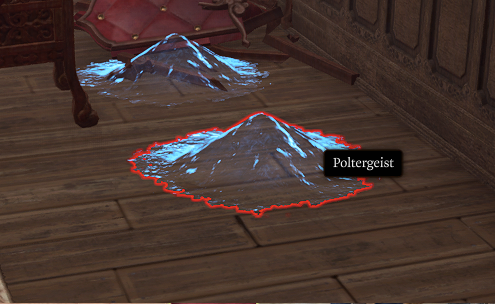
Ownership is a concept interrelated to crime, as it applies to items and other non-player character entities in the game. Any object that is outlined in red when hovered over is owned by another character or entity, restricting the party member's interactions with it; tampering with these objects is considered criminal. Corpses of characters adhere to this rule as well. For example, one or more party members can potentially get away with murdering an NPC, but get in trouble if someone catches them picking up the NPC's red-outlined, "restricted" corpse.
Magnitude[edit section | visual editor]
Crimes vary in magnitude, and the bandwidth for NPC's to tolerate crimes varies based on area and NPC. Some NPC's are annoyed if they witness crime, reducing their attitude to the offender, but take no action. Two NPC's might have different responses to the same crime. One character might try to arrest a party member for stealing, but another might attack them outright.
List of crimes[edit section | visual editor]
The various crimes at the party's disposal are:
- Moving: Moving an object that belongs to another entity. Always[verify] considered a mere attitude-reducing annoyance. A witness to unpermitted moving usually picks up the offended item.
- Vandalism: Destroying an object that belongs to another entity.
- Trespassing: Setting foot in a restricted area or opening a red-outlined door. Can sometimes be rectified by agreeing to leave the area, which instantly teleports the offending character(s) to a neutral area.
- Stealing: Picking up an object that belongs to another entity. Can sometimes be rectified by dropping the item.
- Desecrating: Moving, picking up, destroying, or reanimating a corpse.
- Pickpocketing: Looting an item from a character's inventory using sleight of hand while hiding. Can sometimes, but not always, be rectified by returning the stolen items. Being caught in a failed pickpocket and being caught in possession of a pickpocketed an item are considered separate crimes.
- Assault: Committing a harmful act against another creature. These can be attacks or spells, with some negative condition-applying spells such as


- Murder: Inflicting the


Investigation[edit section | visual editor]
Large, populated locations, such as the Goblin Camp or Druid Grove, have guards who deal with crime. If a civilian witnesses a crime, they can report the crime to one or more guards, who will run over to search for the offending character. If the culprit is nowhere to be found, they will investigate the area for a number of turns before dispersing, forgetting about the crime. Party members cannot talk to NPC's while they are investigating a crime.
However, if a party member interrupts an NPC with 
If the offending character is not able to prevent NPCs from starting an investigation and they call the guards or are searching for the complicit party member, another strategy is to cast 
Questioning[edit section | visual editor]

If the culprit is caught by the guards, interrogatory dialogue begins. On some occasions, the criminal can try to rectify the crime by undoing it or bribing the interrogator. If one commits a crime in a location with a designated jail, the criminal can submit to arrest. Otherwise, the following options are always present: engage in combat, or try to wriggle out of it using a Persuasion, Intimidation, or Deception check. These ability checks generally become more difficult as the magnitude of the crime increases.
Imprisonment[edit section | visual editor]
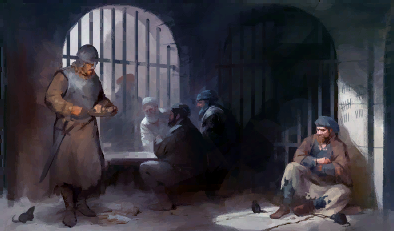
If a party member acquiesces to their crime and is imprisoned, their inventory is removed and they are instantly teleported to a designated jail zone. They retain any equipment they are wearing, but lose access to weapons, torches, instruments, and the rest of their inventory. The apprehended character's inventory is placed, in full, within a nearby Equipment chest while any items they stole (if caught for thievery) are moved to an Evidence chest.[2]
Each of these jail cells has methods of escape baked in so that the character can, with enough ingenuity, escape on their own. For example, the jail cell in the Emerald Grove has a breakable wall and back exit along the side of a cliff, while in the Wyrm's Rock Prison cell the imprisoned character meets an unusual neighbour who may help them.
Fleeing from prison inflicts the temporary 
If a party member uses 
Also, some interactions with NPCs and items can result in the unexpected imprisonment – for example, one of the random effects of drinking 
List of all Jail cells[edit section | visual editor]
- Makeshift Prison within the Emerald Grove (for crimes in the Emerald Grove)
- Worg Pens in the Shattered Sanctum (for crimes in the Goblin Camp and Shattered Sanctum)
- Last Light Inn - Cellar underneath the Last Light Inn (for crimes in the Last Light Inn)
- Moonrise Towers Prison under Moonrise Towers (for crimes in Moonrise Towers)
- Wyrm's Rock Prison in Wyrm's Rock Fortress (for crimes in Rivington, in Wyrm's Crossing and in Wyrm's Rock Fortress)
- Heapside Prison under the Basilisk Gate Barracks (for crimes in the Lower City)
Related conditions[edit section | visual editor]


Rewards[edit section | visual editor]
Outside of the material benefits of the crime itself, crime can pay with Inspirations. Characters with the 


Achievements[edit section | visual editor]

- Escapologist
- Break out of prison after being arrested - aren't you daring?
References[edit section | visual editor]
- ↑ As of Patch #6
- ↑ A bug with possessing the