Ad placeholder
Spells
| Spells |
|---|
 |
| Lists of spells by level |
| Lists of spells by school |
| Lists of spells by class |
| Other lists |
Spells are magical effects that are created by creatures via spellcasting.[1] Spells are frequently cast to deal damage and provide healing, or to inflict conditions on their targets.
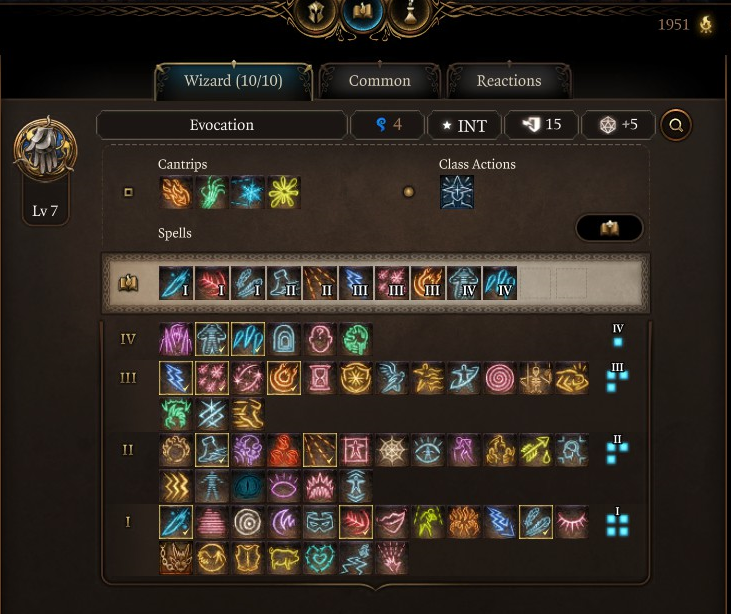
All classes are capable of casting spells with the help of scrolls and magic items, and classes with the Spellcasting or Pact Magic features – called spellcasters – have spell slots they can expend to cast spells they know, without the need for scrolls.
Overview[edit section | visual editor]
Spells are created from the Weave, the magical energies of the multiverse. They are conjured through experience, knowledge, or innate ability, or via the use of scrolls and magical items.
Spell levels[edit section | visual editor]
All spells have a level – a measure of their power and difficulty to cast. To cast a spell, the caster must usually expend a spell slot of sufficient level. Spells cast from scrolls consume the scroll instead and do not consume spell slots when cast, nor do most spells granted by magic items.
Level 0 spells are called cantrips, and can usually be cast at will, without expending a spell slot.[2]
Spellcasting ability[edit section | visual editor]
Most classes – except base fighter and rogue or their subclasses not listed below – have a designated ability known as their spellcasting ability, which represents their capacity to cast spells. Spellcasting ability determines the modifier added to spell attack rolls and spell save DCs.


When casting a spell, the spellcasting ability used depends on whether the spell was learned (first three points below) or cast from an item.
- Spells learned from taking levels in a class use the spellcasting ability modifier of that class.
- Spells learned by transcribing scrolls into a wizard's Spellbook count as wizard spells (because learning from scrolls is a wizard class feature), and thus use Intelligence.
- Spells granted from racial features use a spellcasting ability determined by race.
Item spellcasting ability[edit section | visual editor]
Spells cast from items (including scrolls) and other non-class or race sources, such as illithid powers and free recasts of recastable spells (regardless of source), use the spellcasting ability of the class a character most recently took a first level in. However, when multiclassing into fighter or rogue (except the Eldritch Knight or Arcane Trickster subclasses), a character's spellcasting ability does not change, as these classes do not have their own.
For a fighter or rogue character without a spellcasting subclass, and who is not multiclassed into another class, their default spellcasting ability is used, which is: Intelligence for custom characters, as well as for the Origin characters 


For example, a character who starts with 5 levels in sorcerer will use Charisma for all of their sorcerer spells, as well as spells granted by equipment (e.g., the 

Although Eldritch Knights and Arcane Tricksters only receive a spellcasting ability at level 3, it still only matters when the first level was taken in fighter or rogue. For example, if a character takes their first level in fighter, and then a level in druid, their spellcasting ability will be Wisdom. Even if they then take two more levels in fighter and choose the Eldritch Knight subclass, their spellcasting ability will remain Wisdom, since they took their first level in druid more recently than in fighter.


- There are some class features which are bugged and will incorrectly use the item spellcasting ability, as noted on those features' pages.
- Multiclassing or respeccing into a new class with a different spellcasting ability does not immediately update the ability used by spells granted through equipment. These items must be unequipped and re-equipped before the new ability is used.


Spell properties[edit section | visual editor]
Each spell belongs to a school, which defines its general purpose, and all spells have a range at which they can be cast and a specified target or area of effect. A spell may have an instantaneous effect when cast (for example, a projectile attack), or a spell may have an effect which persists for a specified duration (measured in turns).
Most spells can be interrupted by 

Schools of magic[edit section | visual editor]
Every spell belongs to one of eight schools of magic: abjuration, conjuration, divination, enchantment, evocation, illusion, necromancy, or transmutation. Some class features only benefit spells of a specific school.
Casting time[edit section | visual editor]
All spells have a casting time that determines whether it requires the caster to take an 


Spell saves[edit section | visual editor]
Harmful spells which do not require an attack roll and target an area or a specific point in space – or affect a target directly – allow targeted creatures to attempt a saving throw (save) against the spell, potentially reducing or ignoring the spell's effects.
The Difficulty Class (DC) of these saves – called the spell save DC – is generally based on the caster's spellcasting DC:
- Examples of spells that require saves


Certain equipment worn by the caster can also affect their spell save DCs.
Spell attack rolls[edit section | visual editor]
Some harmful spells – typically those cast in the form of rays or projectiles – require the caster to make an attack roll against the target's Armour Class (AC) in order to determine if their spell attack hits or misses.
The caster adds their spellcasting ability modifier, as well as their proficiency bonus, to the results of the attack roll:

- Examples of spells that require spell attacks


Concentration[edit section | visual editor]
Most spells with a duration require 
Ending concentration[edit section | visual editor]

Although concentration typically lasts for a spell's full duration, or until another concentration spell is cast, there are multiple ways for concentration to break:
- Manually
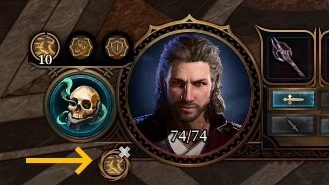
- Concentration can be ended by the player at any time via the "X" on the current concentration spell's icon, displayed next to the caster's main portrait.
- Taking damage
- Any time a creature concentrating on a spell takes damage, they make a Constitution saving throw against a DC equal to half the damage taken, or 10, whichever is higher.[3] If the save fails, concentration ends.
- Conditions
- Some conditions – such as


- Long rests
- Taking a long rest ends concentration.
- Dismissing companions
- Sending a companion to camp or otherwise removing them from the active party ends their concentration.


Spellcasters[edit section | visual editor]
Spellcasters can be full casters – meaning they can learn up to 6th level spells, half casters – meaning they can learn up to 3rd level spells, or one-third casters – meaning they can learn up to 2nd level spells. Non-spellcasters do not gain or add spell slots.
Full casters[edit section | visual editor]


![Warlock[4]](/w/images/thumb/6/66/Class_Warlock_Badge_Icon.png/240px-Class_Warlock_Badge_Icon.png.webp)

Half casters[edit section | visual editor]


One-third casters[edit section | visual editor]


Non-spellcasters[edit section | visual editor]


Known spells[edit section | visual editor]
Known spells are generally spells learned from taking levels in a class with the Spellcasting or Pact Magic features. Each caster class has access to its own list of spells, though there can be significant overlap between classes.
The following classes must learn spells through levelling up:


These classes, with the exception of wizard, also have access to the Replacement Spell feature, which allows them to swap a known spell each time a new level is taken in them. Wizards can instead learn new spells from scrolls, without needing to give up an already known spell.
The following classes automatically learn all their available spells when a level is taken in them:


Prepared spells[edit section | visual editor]

Prepared spellcasters include:
The number of prepared spells each class can have at a time is equal to spellcasting ability modifier + class level (minimum of 1).
Additionally, spells granted by racial features or by certain class features (such as a cleric's Domain Spells) are always prepared and do not count towards a class's maximum number of prepared spells.
Some spells with ongoing effects that do not require concentration, such as 

Spell slots[edit section | visual editor]
All spellcasters have spell slots, which they expend to cast their known spells. 
A spell of a given level requires a spell slot of the same level or higher to be expended to cast it. Many spells will be 
Spellcasting[edit section | visual editor]
| ESL |  |
 |
 |
 |
 |
 |
|---|---|---|---|---|---|---|
| 1 | 2 | - | - | - | - | - |
| 2 | 3 | - | - | - | - | - |
| 3 | 4 | 2 | - | - | - | - |
| 4 | 4 | 3 | - | - | - | - |
| 5 | 4 | 3 | 2 | - | - | - |
| 6 | 4 | 3 | 3 | - | - | - |
| 7 | 4 | 3 | 3 | 1 | - | - |
| 8 | 4 | 3 | 3 | 2 | - | - |
| 9 | 4 | 3 | 3 | 3 | 1 | - |
| 10 | 4 | 3 | 3 | 3 | 2 | - |
| 11 | 4 | 3 | 3 | 3 | 2 | 1 |
| 12 | 4 | 3 | 3 | 3 | 2 | 1 |
A caster's available Spellcasting spell slots are determined by the caster's effective spellcaster level (ESL). A full caster's ESL is exactly their class level, whereas the ESL of half-casters and one-third casters is equal to half or one-third their level, rounded up.
When multiple classes with the Spellcasting feature are chosen for a character, the creature's total ESL is instead the summed fractional spellcaster level of every individual spellcasting class they have taken a level in, rounded down. For example, a character who has taken five levels in 

Arcane Tricksters have unique Spell Slots per Spell Level if multiclassing after level 10, with 
Pact Magic[edit section | visual editor]
Warlocks do not cast spells through the Spellcasting feature, but through their unique Pact Magic feature. Spell slots granted by Pact Magic are always of the highest level the warlock can cast, and are replenished on a short rest. Spells cast using Pact Magic are always upcast at the highest possible level.
To distinguish them from Spellcasting spell slots, Pact Magic spell slots have a unique colour: 
Spell slots gained from Pact Magic are calculated differently from those gained from Spellcasting. As such, levels taken in warlock are ignored when calculating ESL.
Shadow Spell Slot[edit section | visual editor]
Playing as Gale origin can grant him a 
Other uses of spell slots[edit section | visual editor]
Some wizard subclass features (such as 


Ritual spells[edit section | visual editor]
When a 


Scrolls[edit section | visual editor]
Spells can be cast from scrolls that are bought, found or looted. Spells cast from scrolls cannot be upcast (cast with a higher-level spell slot for additional benefits), but they can benefit from metamagic. Unlike in D&D 5e, scrolls cannot be created. Wizards can learn spells from scrolls (transcribe the spell from a scroll into their spellbook), consuming the scroll in the process. See transcribing scrolls.
See also[edit section | visual editor]
Notes[edit section | visual editor]
- ↑ The term spellcasting refers both to the act of casting spells and to the Spellcasting class feature. The latter is always capitalised, whereas the former is generally not.
- ↑ Some cantrips, such as


- ↑ Constitution saves are sometimes erroneously referred to as Constitution checks.
- ↑ Warlocks have the Pact Magic feature, which functions similarly to Spellcasting.


External links[edit section | visual editor]